
Israel elects the 26th Knesset on Tuesday, 27 October. From the end of this Friday until the polling stations close at 22:00 on election day, Israeli law allows no new polls to be published. The polls of this week are therefore the last word before the vote, and this is where they leave the race: Likud and Yashar tied at 23 seats each, the Netanyahu coalition and the opposition tied at 53 seats each, and nobody anywhere near 61.
This post sums up every poll since the campaign began on 9 September, the way our nowcast for Israel reads them: one election trend across all institutes, a seat projection with the 3.25 per cent threshold and the surplus-vote agreements, and the map of the sub-districts. The numbers are those of the trend of Thursday, 22 October, the last one before the blackout.
The five things to know
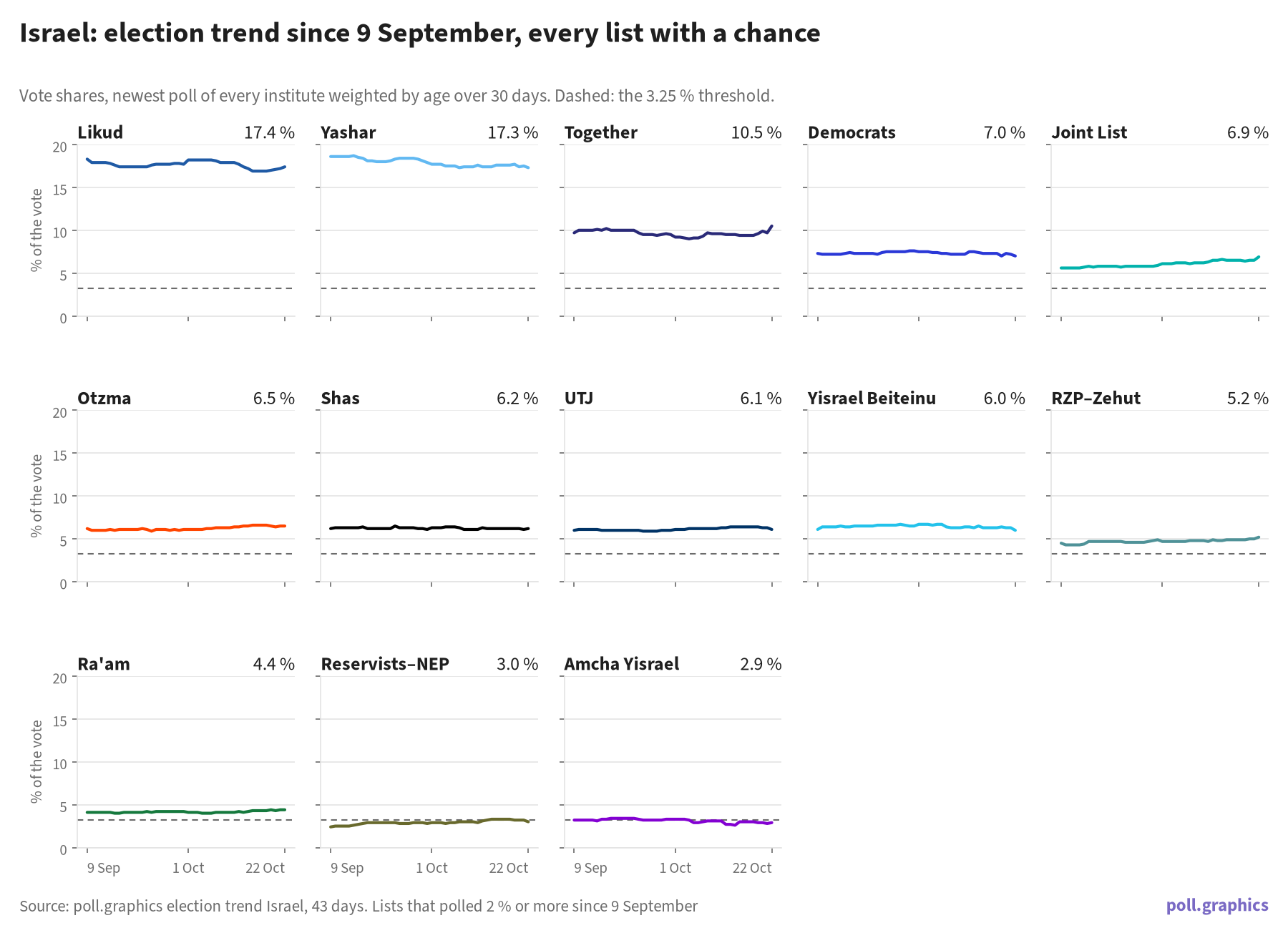
- A dead heat at the top. Gadi Eisenkot’s new party Yashar and Benjamin Netanyahu’s Likud both stand at 23 seats. In the trend, Likud has 17.4 per cent of the vote and Yashar 17.3. The lead has changed hands three times since September: Likud took it at the start of October, Yashar took it back in the middle of the month, and with Thursday’s polls Likud is ahead again, by a tenth of a point.
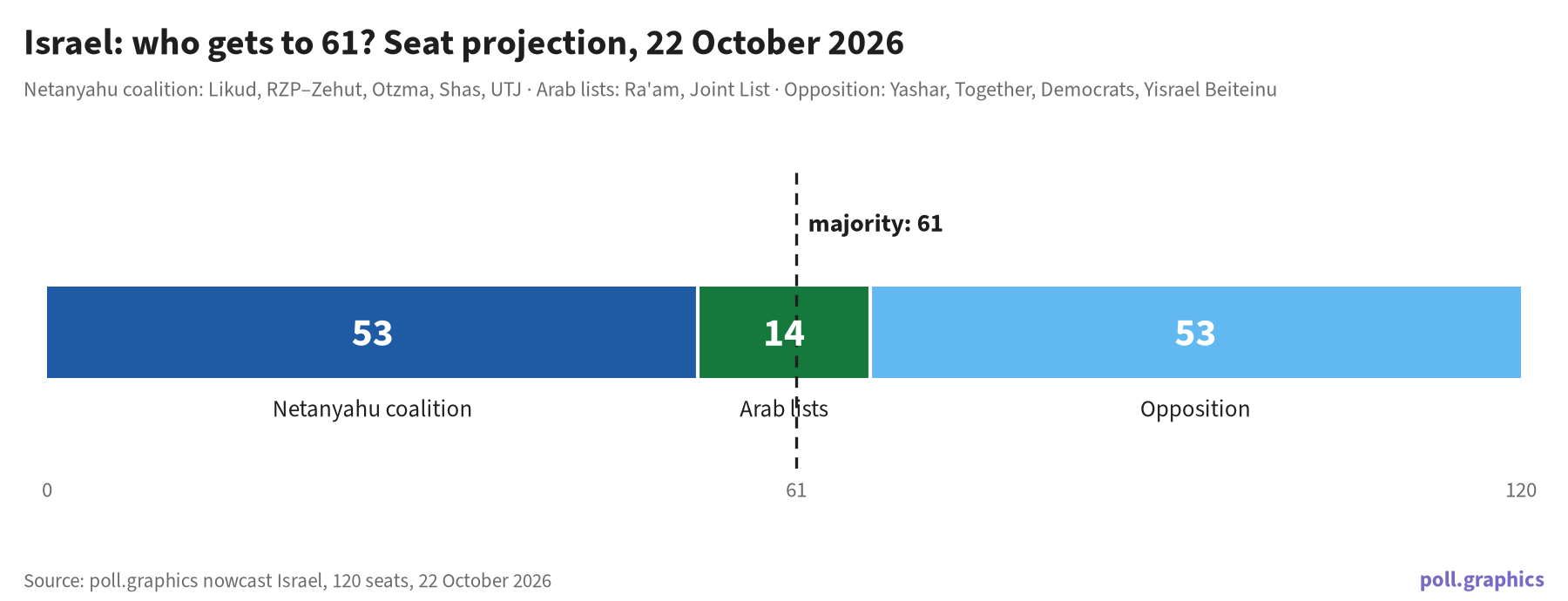
- 53 against 53. The parties of the current coalition (Likud, RZP–Zehut, Otzma Yehudit, Shas, UTJ) come to 53 seats. The Zionist opposition (Yashar, Together, the Democrats, Yisrael Beiteinu) also comes to 53. The two Arab lists hold the remaining 14.
- No bloc reaches 61 on its own. Even with Avigdor Lieberman’s Yisrael Beiteinu (7), Netanyahu’s coalition would reach 60, one short. The opposition would need Ra’am (5) and still fall short at 58, or both Arab lists to reach 67.
- The threshold decides. Two lists sit just under the 3.25 per cent line: the Reservists–New Economic Party at 3.0 per cent and Amcha Yisrael at 2.9. If either gets in, it takes about four seats off everyone else, and 53:53 becomes something else.
The seat projection
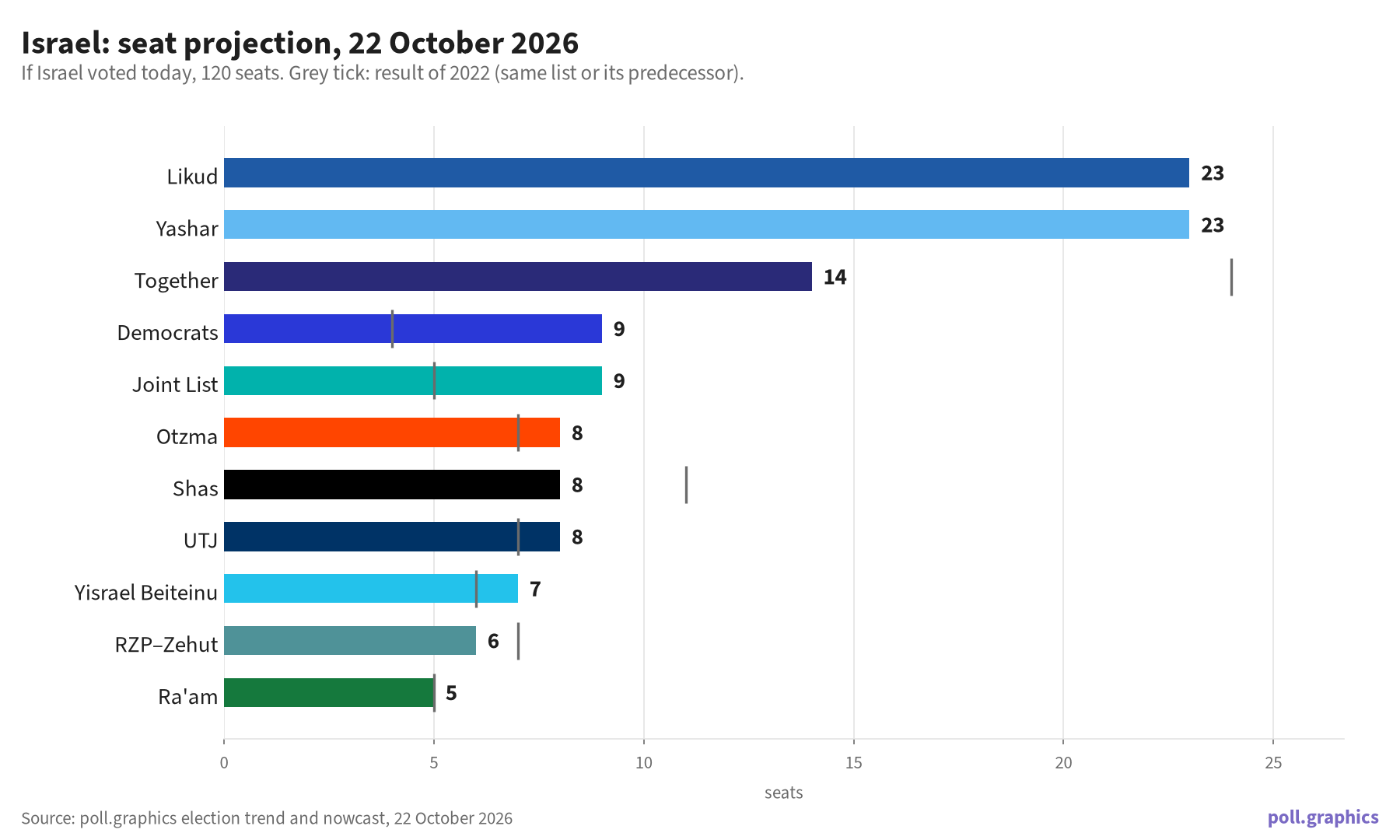
If Israel voted today, the 120 seats would be shared by eleven lists. Four of them are new or newly combined since 2022: Yashar (Eisenkot), Together (Naftali Bennett’s list with Yair Lapid’s Yesh Atid), the Democrats (Labor and Meretz merged) and the Joint List (Hadash–Ta’al and Balad back together). The Religious Zionist Party and Otzma Yehudit, which ran as one list in 2022 and won 14 seats, run separately this time and project 6 and 8.
| List | Trend | Seats | 2022 | Change |
|---|---|---|---|---|
| Likud | 17.4 % | 23 | 32 | -9 |
| Yashar | 17.3 % | 23 | 0 (new) | +23 |
| Together | 10.5 % | 14 | 24 (as Yesh Atid) | -10 |
| Democrats | 7.0 % | 9 | 4 (as Labor) | +5 |
| Joint List | 6.9 % | 9 | 5 (as Hadash–Ta’al) | +4 |
| Otzma | 6.5 % | 8 | 7 (RZ–Otzma joint list, 14 seats) | |
| Shas | 6.2 % | 8 | 11 | -3 |
| UTJ | 6.1 % | 8 | 7 | +1 |
| Yisrael Beiteinu | 6.0 % | 7 | 6 | +1 |
| RZP–Zehut | 5.2 % | 6 | 7 (RZ–Otzma joint list, 14 seats) | |
| Ra’am | 4.4 % | 5 | 5 | ±0 |
| Reservists–NEP | 3.0 % | 0 | 0 (new) | ±0 |
| Amcha Yisrael | 2.9 % | 0 | 0 (new) | ±0 |
Election trend: newest poll of every institute, weighted by age over 30 days. Seats: the nowcast applies the 3.25 % threshold and the surplus-vote agreements. Change: seats of 2022 of the same list or its predecessor.
The grey ticks in the chart show how far the map has moved since 2022. Likud is down from 32 seats to 23. Yesh Atid, which won 24 on its own in 2022, is now part of Together at 14. Benny Gantz’s National Unity, 12 seats in 2022, has gone: Blue and White polled under one per cent all campaign and announced on 19 October that it was pulling out. Shas drops from 11 seats to 8, United Torah Judaism edges up from 7 to 8.
53, 14, 53: the arithmetic of 61
Israeli election nights are counted in blocs, and the blocs are what the campaign has been about. The chart puts the projection on one bar.
| Bloc | Seats | Lists |
|---|---|---|
| Netanyahu coalition | 53 | Likud 23, RZP–Zehut 6, Otzma 8, Shas 8, UTJ 8 |
| Arab lists | 14 | Ra’am 5, Joint List 9 |
| Opposition | 53 | Yashar 23, Together 14, Democrats 9, Yisrael Beiteinu 7 |
120 seats, 61 for a majority.
Three things follow from 53:14:53.
Netanyahu’s shortest route is Lieberman. The coalition parties plus Yisrael Beiteinu make 60, one seat short on Thursday’s numbers (earlier this week it was exactly 61). Lieberman left Netanyahu’s camp in 2019 over the ultra-Orthodox draft and has campaigned against the Haredi parties ever since, so the closest arithmetic is also the one the campaign has made hardest. Together (14) would be the alternative, and Bennett has run on replacing Netanyahu.
The opposition cannot get there without the Arab lists. Yashar, Together, the Democrats and Yisrael Beiteinu are 53. With Ra’am, which sat in the Bennett–Lapid government of 2021, they reach 58. Only with the Joint List as well do they pass 61, and no Zionist party has campaigned on that.
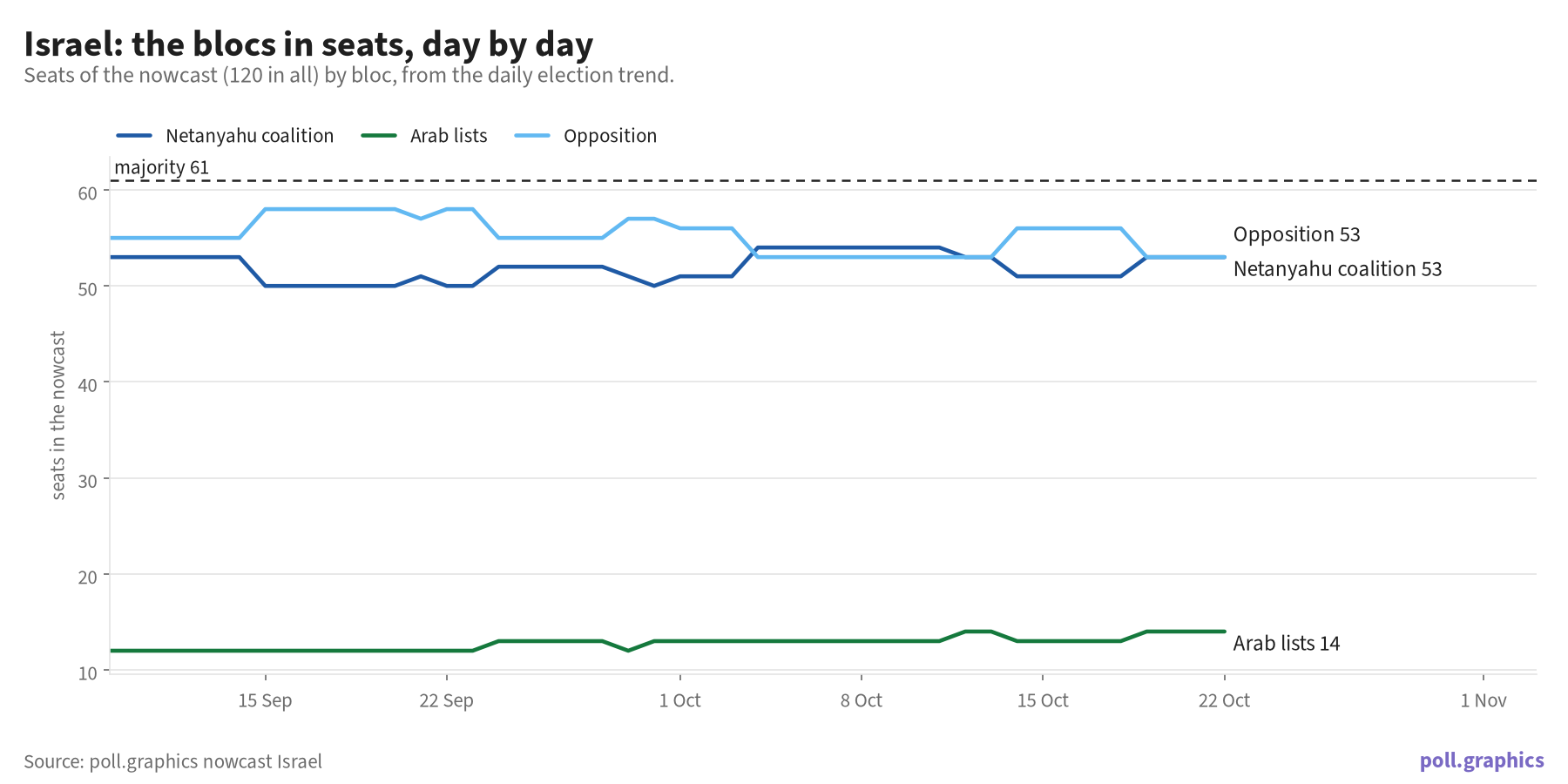
The blocs have barely moved. Since 9 September the coalition has stayed between 50 and 54 seats in our trend and the opposition between 53 and 58. What has moved is inside the blocs: the Arab lists have gained two seats (from 12 to 14), mostly because the Joint List rose from 5.6 to 6.9 per cent, and Yashar has given up a little of its early lead.
The threshold: 3.25 per cent, and two lists right under it
The lists under the threshold are not in the seat table, but they are the most important number on election night. The Reservists–New Economic Party of Yoaz Hendel and Yaron Zelekha stands at 3.0 per cent in our trend. Ofer Winter’s Amcha Yisrael stands at 2.9. Both have been shown at four seats by some institutes and left out by others.
If one of them passes 3.25 per cent, it takes about four seats, and those seats come from every other list roughly in proportion to its size, about two from each bloc. If both pass, eight seats move. If both fail, around seven per cent of all votes are discarded, counting the smaller lists, which is why every other list gains a little in the projection. Nothing else in this election swings the result as much as these two lines, and no poll can measure a party at three per cent to within a point.
The polls behind the trend
Eight institutes have polled since the trend’s 30-day window opened, 61 polls since 9 September in all. The trend since September, as vote shares, for every list that has polled 2 per cent or more, each on the same scale from zero, with the threshold as a dashed line:
On the map
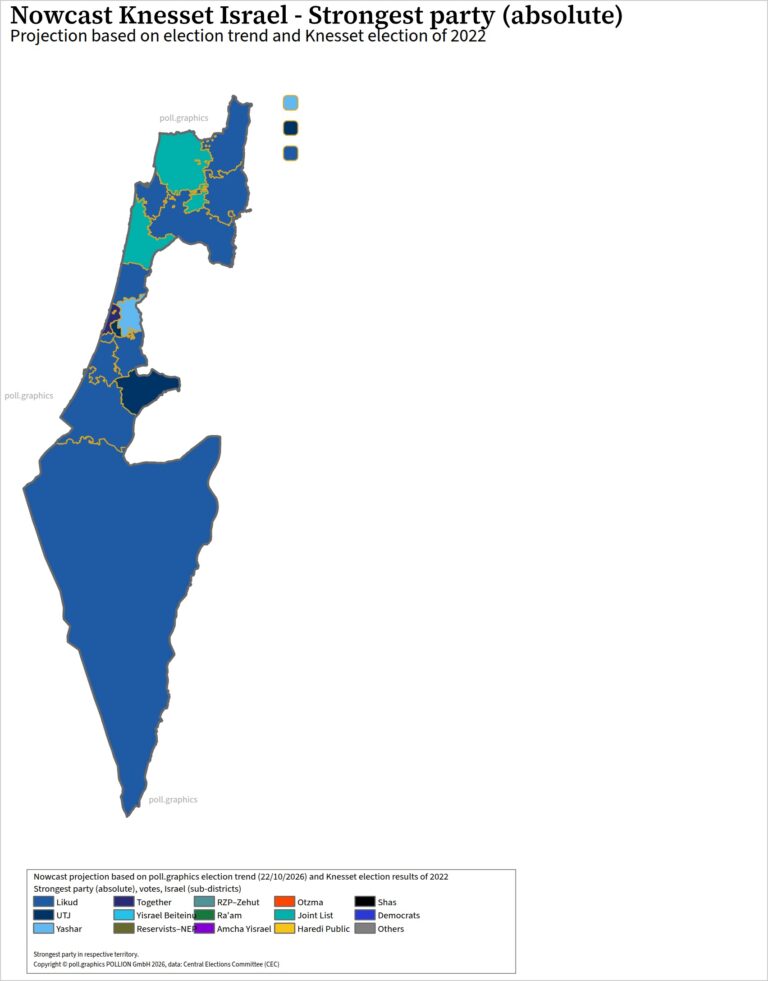
Israel is one constituency, so the map changes nothing about who gets a seat. It shows where the votes come from. The nowcast applies the national trend to the 2022 result in each of the 18 sub-districts, plus the Golan Heights, the settlements in the West Bank and the “double envelopes” (soldiers, diplomats, hospital patients and prisoners, counted separately).
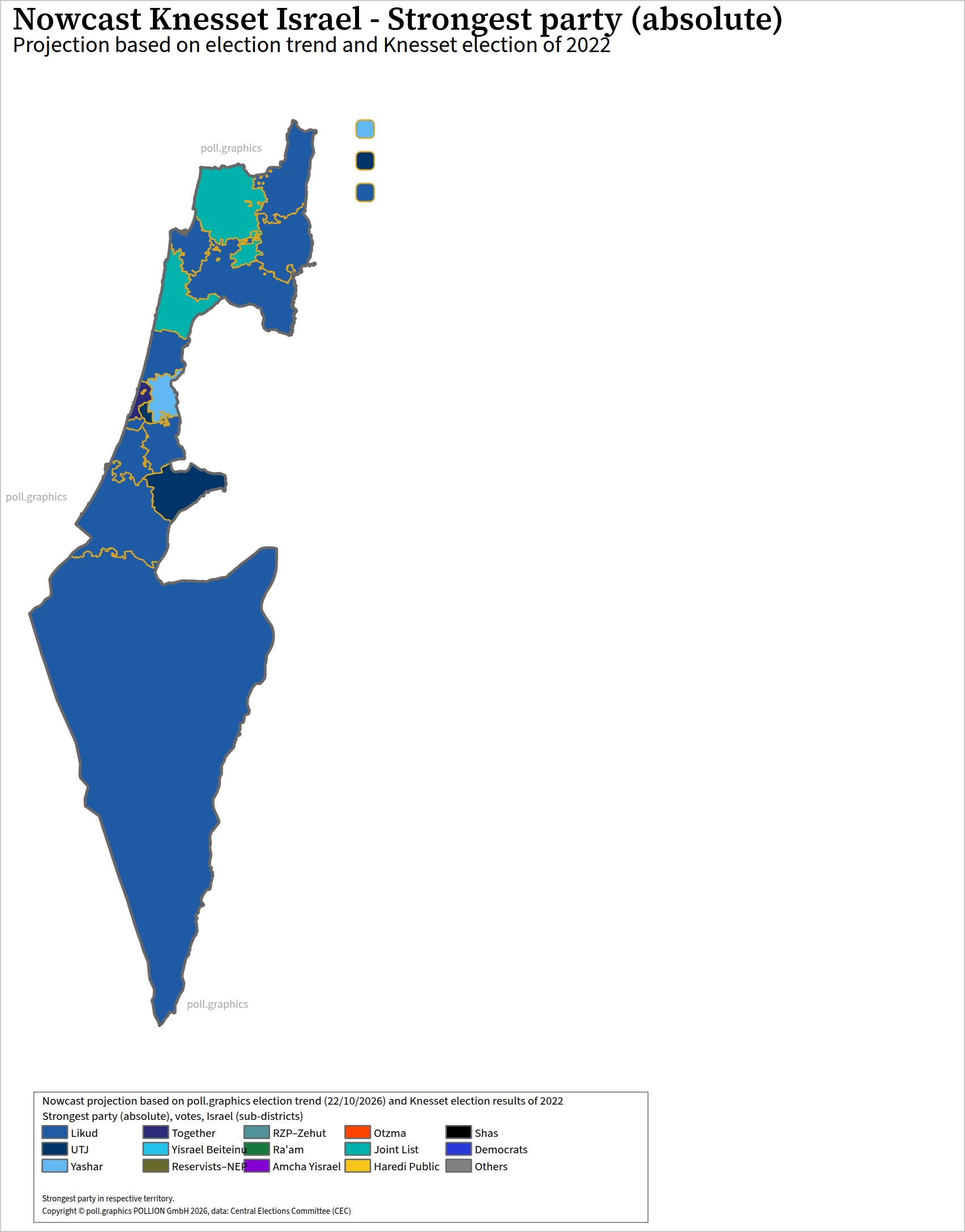
Likud is the strongest list in 11 of the 20 units, from the north around the Sea of Galilee down to Be’er Sheva and the south. The Joint List leads in Akko, in the Nazareth half of the Jezreel Valley and, in a change from 2022, in Hadera. Yashar leads in Petah Tikva and on the Golan Heights, where Yesh Atid was first in 2022 and where Eisenkot’s new party inherits that space. Together takes Tel Aviv, where Yesh Atid was first in 2022. Likud keeps the double envelopes it won four years ago. United Torah Judaism is first in Jerusalem, in the Ramat Gan sub-district (that is Bnei Brak) and in the settlements, where the split of the Religious Zionist list hands the top spot to the Haredi party.
| Sub-district | 2022 lead | Nowcast lead | 2nd | 3rd |
|---|---|---|---|---|
| Jerusalem (including East Jerusalem, which the official data does not separate) | UTJ | UTJ | Yashar | Likud |
| Zefat | Likud | Likud | Yashar | Otzma |
| Kinneret | Likud | Likud | Yashar | Shas |
| Yizre’el (Afula) | Likud | Likud | Yashar | Together |
| Akko | Hadash–Ta’al | Joint List | Yashar | Ra’am |
| Yizre’el (Nazareth) | Hadash–Ta’al | Joint List | Ra’am | Yashar |
| Occupied territory: Golan Heights | Yesh Atid | Yashar | Likud | Together |
| Haifa | Likud | Likud | Yashar | Together |
| Hadera | Likud | Joint List | Yashar | Likud |
| Sharon | Likud | Likud | Yashar | Joint List |
| Petah Tiqwa | Yesh Atid | Yashar | Likud | Together |
| Ramla | Likud | Likud | Yashar | Together |
| Rehovot | Likud | Likud | Yashar | Together |
| Tel Aviv | Yesh Atid | Together | Democrats | Yashar |
| Ramat Gan | UTJ | UTJ | Yashar | Likud |
| Holon | Likud | Likud | Yashar | Together |
| Ashqelon | Likud | Likud | Yashar | Yisrael Beiteinu |
| Be’er Sheva | Likud | Likud | Ra’am | Yashar |
| Occupied territory: West Bank (Israeli settlements) | RZ–Otzma | UTJ | Otzma | Yashar |
| Double envelopes | Likud | Likud | Yashar | Together |
The nowcast applies the national trend to the 2022 result of every sub-district: a projection, not a local poll.
What to watch on Tuesday night
- 22:00: polls close and the three television exit polls are published. In 2022 they were two to three seats short of the coalition’s final 64.
- The threshold first. Before anything else, the Reservists–NEP and Amcha Yisrael at 3.25 per cent. Four seats each hang on it.
- Likud or Yashar first? The President asks the party leaders whom they recommend, so the largest list matters less than in other countries. But the first place is the story of the night.
- The last seats. The surplus-vote agreements (Likud with RZP–Zehut, Together with Yisrael Beiteinu, Yashar with the Democrats, the Joint List with Ra’am, Shas with UTJ) decide the final two or three seats, and double envelopes are counted last. In 2022 the count took until the Thursday to settle the last seats. Official results are due on 4 November.
Our nowcast page freezes with this trend for the blackout and reopens with the results. The fact check of this projection, seat by seat, follows once the count is final.
Full access for the election: ₪34.99 for one month, monthly, cancel any time.
Unlock all 17 constituencies
Yearly −50%
₪17.49/Month
₪209.90 per year
Method: the poll.graphics election trend takes the newest poll of every institute, weighted linearly by age over 30 days, after converting the published seat numbers to vote shares. The seat projection applies the 3.25 per cent threshold, the D’Hondt (Bader–Ofer) allocation and the registered surplus-vote agreements. The map applies the national trend to the 2022 result of each sub-district (Central Elections Committee). Sources of the polls: the institutes, as collected on Wikipedia’s polling page for the 2026 election.